



Search is evolving faster than ever. For years, businesses relied on Search Engine Optimization
(SEO) to improve visibility in traditional search engines like Google and Bing. The goal was
straightforward: create valuable content, optimize it for relevant keywords, and earn higher
rankings in search engine results pages (SERPs).
Today, the search landscape is expanding beyond traditional search engines. AI-powered
platforms such as ChatGPT, Google AI Overviews, Gemini, Perplexity, and Microsoft Copilot
are changing how people discover information. Instead of presenting users with a list of links,
these platforms often generate direct, conversational answers by synthesizing information from
multiple sources.
This shift has introduced a new optimization discipline known as Generative Engine
Optimization (GEO). Rather than focusing solely on ranking webpages, GEO aims to improve
how frequently and accurately a brand or its content is referenced within AI-generated responses.
As AI-powered search continues to mature, businesses are asking an important question:
Should you focus on SEO or GEO?
The answer isn’t about choosing one over the other. Both serve different purposes within today’s
search ecosystem. Understanding how each works, and where they complement each other, is
becoming an important part of a modern digital marketing strategy.
What Is Search Engine Optimization (SEO)?
Search Engine Optimization (SEO) is the practice of improving a website so it appears more
prominently in the organic results of traditional search engines such as Google and Bing. Its
primary objective is to increase qualified, unpaid traffic by making webpages more relevant and
accessible to search engine algorithms.
When users enter a search query, search engines evaluate millions of webpages before displaying
the most relevant results. SEO helps search engines better understand a website’s content,
allowing it to compete for higher positions on the search results page.
A comprehensive SEO strategy typically includes several core areas:
- Keyword optimization to align content with the terms users search for.
- High-quality, relevant content that addresses user needs and search inten
- Technical SEO to improve crawlability, indexing, page speed, mobile usability, and overall site performance.
- Logical site architecture that makes information easy for both users and search engines tonavigate.
- Authority-building efforts, including backlinks and signals that demonstrate credibility.
The primary success metrics for SEO include:
- Organic traffic
- Keyword rankings
- Click-through rate (CTR)
- Search visibility
- User engagement and conversions
Although AI-powered search experiences are changing how people find information, traditional search engines continue to play a significant role in driving website traffic. For many organizations, SEO remains a foundational component of digital marketing because it helps users discover content through organic search results and encourages visits to their websites.
What Is Generative Engine Optimization (GEO)?
Generative Engine Optimization (GEO) is the practice of optimizing digital content so it is more
likely to be referenced, cited, or incorporated into responses generated by AI-powered search
platforms and conversational assistants.
Unlike traditional search engines that display ranked lists of webpages, generative AI platforms
respond to user prompts by producing synthesized answers. These responses may reference
multiple sources, summarize key information, or cite brands and websites that the AI considers
relevant and trustworthy.
The objective of GEO is not simply to rank a webpage. Instead, it is to improve a brand’s
visibility within AI-generated answers across platforms such as:
- ChatGPT
- Google AI Overviews
- Google AI Mode
- Google Gemini
- Microsoft Copilot
- Perplexity
- Claude
Because AI systems generate responses differently from traditional search engines, GEO places
greater emphasis on creating content that is clear, authoritative, and easy for AI models to
understand and reference. The analyzed resources consistently highlight characteristics such as:
- Clear and direct explanations
- Well-structured content
- Credible statistics and supporting evidence
- Quotations from reliable sources
- Frequently Asked Questions (FAQs)
- Conversational language that directly addresses user questions
Success in GEO is measured differently from traditional SEO. Instead of focusing primarily on
rankings and clicks, organizations evaluate whether their brand or content is cited, mentioned, or
recommended within AI-generated responses, helping improve visibility and brand awareness in
AI-assisted search experiences.
GEO vs. SEO: Key Differences
Although both SEO and GEO aim to increase a brand’s online visibility, they optimize for
different search experiences and measure success in different ways. Traditional SEO focuses on
helping webpages rank in search engine results, while GEO focuses on increasing the likelihood
that AI-powered search platforms will reference or cite a brand when generating responses to
user prompts.
The following comparison summarizes the key differences between the two approaches.
| Feature | SEO | GEO |
| Primary Goal | Improve rankings in traditional search engines | Increase visibility within AI-generated responses |
| Target Platforms | Google, Bing, Yahoo | ChatGPT, Google AI Overviews, Gemini, Perplexity, Microsoft Copilot, Claude |
| Search Experience | Users receive a ranked list of webpages | Users receive a synthesized answer generated by AI |
| Primary Success Metric | Organic traffic, keyword rankings, clicks | Brand mentions, citations, and inclusion in AI-generated answers |
| Content Focus | Keyword relevance, technical optimization, topical authority | Clear explanations, structured information, authoritative sources, conversational answers |
| Optimization Approach | Technical SEO, on-page SEO, backlinks, content quality | Content designed to be understandable, trustworthy, and easily referenced by AI systems |
| Website Traffic | Drives direct traffic to webpages | Primarily improves visibility and brand awareness; may generate less direct traffic |
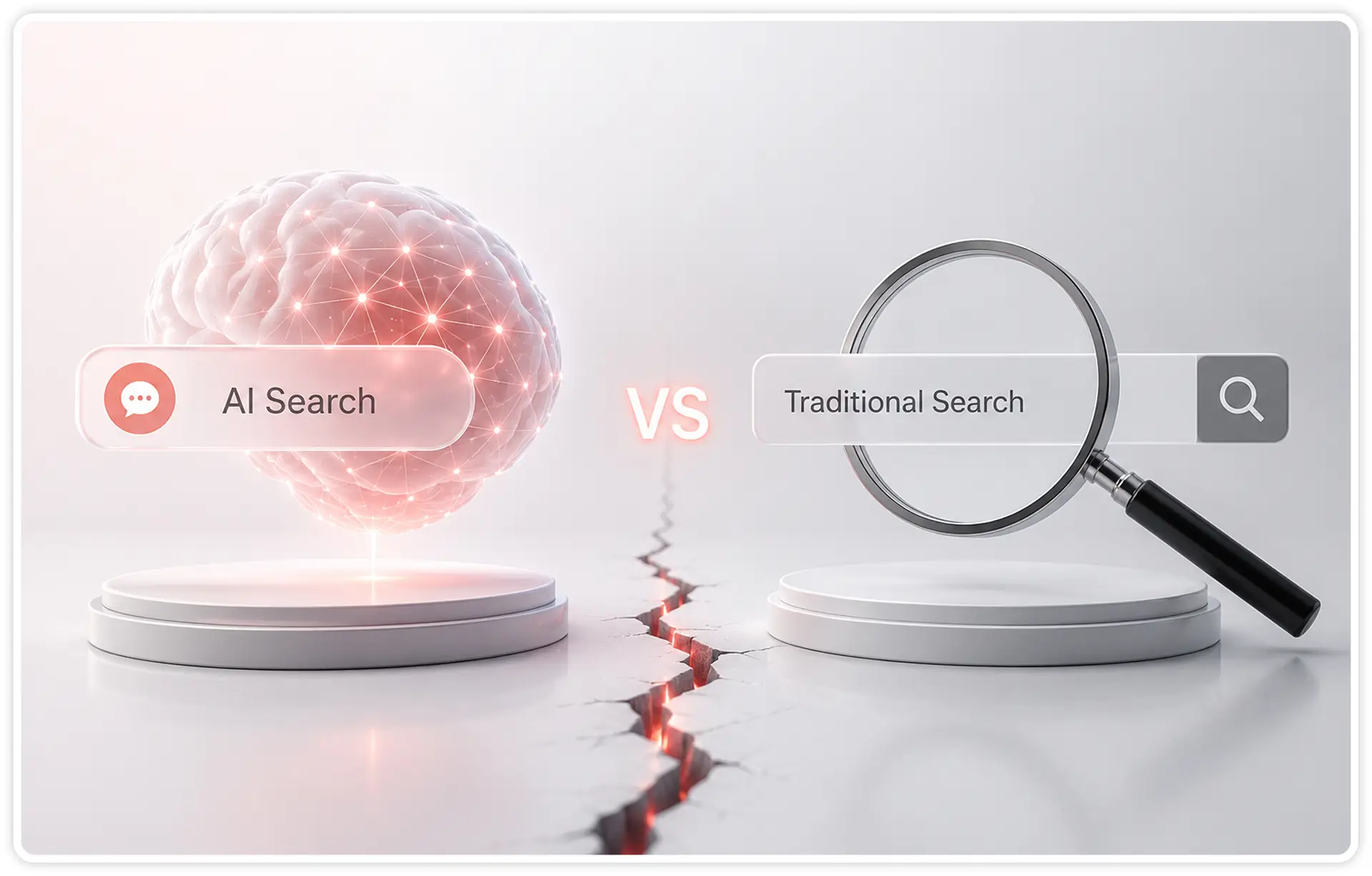
The comparison makes one point clear: GEO is not designed to replace SEO. Instead, each
addresses a different way users discover information online.
Different Search Experiences, Different Optimization Goals
In a traditional search engine, a user typically enters a keyword or phrase and receives a page of
ranked links. They evaluate the results, choose a webpage, and visit the site for more
information.
AI-powered search works differently. Users ask complete questions or describe a task, and the AI
generates a direct response by combining information from multiple sources. Depending on the
platform, the response may also cite or reference the sources used to generate the answer.
Because of this shift, optimization priorities also change.
For SEO, success depends on helping search engines understand and rank webpages effectively.
For GEO, success depends on creating content that AI systems recognize as reliable, relevant,
and suitable for inclusion in generated responses.
How AI Search Is Changing Online Visibility
The growth of generative AI is changing not only how search engines present information but
also how users interact with search results.
Instead of browsing through multiple webpages, many users now expect immediate answers. AI-
powered platforms summarize information, compare options, explain concepts, and answer
follow-up questions within the same conversation. This creates a more conversational search
experience than the traditional “ten blue links” model.
For businesses, this evolution changes what online visibility looks like.
Previously, visibility largely meant appearing near the top of search engine results pages. In AI-
driven search, visibility increasingly includes being referenced within the answer itself. Even if
users never click through to a website, seeing a company’s name or content cited in an AI-
generated response can influence awareness and credibility.
However, traditional search has not disappeared. Search engines continue to generate substantial
organic traffic, and SEO remains a critical channel for attracting visitors to a website. At the
same time, AI search introduces an additional opportunity for brands to expand their reach in
environments where users may never interact with conventional search results.
Rather than viewing this as a replacement of one strategy with another, the analyzed sources
consistently present it as an expansion of the search ecosystem. Businesses that understand both
traditional search optimization and AI search optimization will be better positioned to maintain
visibility as user behavior continues to evolve.
How SEO and GEO Work Together
As AI-powered search becomes more common, it’s easy to assume that GEO will replace SEO.
However, the analyzed resources consistently emphasize that these are complementary strategies
rather than competing ones. Each addresses a different search experience and serves a distinct
business objective.
SEO continues to play a critical role in helping websites appear in traditional search engine
results and generate organic traffic. GEO extends that visibility into AI-powered search
experiences by increasing the likelihood that a brand’s content will be referenced or cited in AI-
generated answers.
In practice, many optimization efforts support both strategies. Producing accurate, well-
structured, high-quality content benefits traditional search engines while also making
information easier for AI systems to understand and reference. Likewise, establishing authority
and trust helps improve visibility across both search environments.
Rather than asking whether SEO or GEO is more important, businesses should consider how
both contribute to a comprehensive search strategy. SEO helps users find and visit your website,
while GEO helps ensure your brand remains visible when users receive answers directly from AI
platforms.
Best Practices for SEO and GEO
Although SEO and GEO have different objectives, they share a common foundation: creating
valuable, trustworthy content that satisfies user intent.
SEO Best Practices
An effective SEO strategy should continue to focus on established optimization techniques,
including:
- Create high-quality, original content that addresses user intent.
- Perform keyword research and optimize content naturally.
- Use descriptive headings and logical content hierarchy.
- Improve page speed, mobile usability, and technical performance.
- Build topical authority through comprehensive content.
- Earn high-quality backlinks from reputable websites.
- Maintain a clear internal linking structure.
GEO Best Practices
Because AI systems generate answers differently than traditional search engines, GEO
emphasizes content that is easy to interpret and reference.
The analyzed sources recommend practices such as:
- Write clear, direct answers to common questions.
- Support claims with credible statistics and quotations from reliable sources.
- Include citations where appropriate.
- Organize information with descriptive headings and structured formatting.
- Add FAQ sections that mirror conversational search queries.
- Use natural language that aligns with how users ask questions in AI-powered search.
These practices not only improve AI visibility but also enhance readability and user experience,
making them valuable additions to an overall content strategy.
Which Strategy Should Your Business Focus On?
The answer depends less on choosing one strategy and more on adapting to how people search
today.
If your objective is to attract visitors from traditional search engines, SEO remains essential.
Ranking well in search results continues to be one of the most effective ways to drive qualified
organic traffic to your website.
If your goal is to increase visibility within AI-generated answers, GEO deserves growing
attention. As more users rely on conversational AI tools to research products, compare solutions,
and answer questions, being referenced within those responses can strengthen brand awareness
and credibility.
For most organizations, the strongest approach is to combine both strategies:
- Continue investing in SEO to maintain search rankings and organic traffic.
- Expand your content strategy to support GEO and improve AI visibility.
- Monitor how your brand appears across both traditional search engines and AI-powered search platforms.
Instead of viewing GEO as a replacement for SEO, businesses should see it as an evolution of
search optimization that reflects changing user behavior.
Conclusion
Search is entering a new phase where traditional search engines and AI-powered search
experiences coexist. While the way users discover information is changing, the need for
trustworthy, high-quality content remains constant.
SEO continues to be the foundation for improving visibility in search engine results and driving
organic website traffic. GEO builds on that foundation by helping brands become part of AI-
generated conversations and answers.
Rather than replacing one another, SEO and GEO represent two complementary approaches to
reaching users wherever they choose to search. Organizations that adapt their content strategies
to support both will be better positioned as search continues to evolve.
Frequently Asked Questions
What is Generative Engine Optimization (GEO)?
Generative Engine Optimization (GEO) is the practice of optimizing content so it is more likely
to be cited or referenced by AI-powered search platforms such as ChatGPT, Google AI
Overviews, Gemini, Microsoft Copilot, Claude, and Perplexity.
Is GEO replacing SEO?
No. The analyzed resources consistently conclude that GEO complements rather than replaces
SEO. Traditional search engines remain a major source of website traffic, while GEO expands
visibility within AI-generated search experiences.
What is the biggest difference between GEO and SEO?
SEO focuses on improving rankings in traditional search engines, whereas GEO focuses on
increasing a brand’s presence in AI-generated responses. They optimize for different search
environments and measure success differently.
Can SEO and GEO work together?
Yes. Many content quality principles, such as creating authoritative, well-structured, and user-
focused content, support both SEO and GEO. Organizations are encouraged to incorporate both
strategies into their overall digital marketing efforts.
How do businesses measure GEO success?
Unlike SEO, which often measures rankings and organic traffic, GEO focuses on metrics such as
AI citations, brand mentions, visibility within AI-generated responses, and referral traffic from
AI platforms where available.